
Monday, January 20, 2014
Winter in Seoul 2014
This winter has been very mild and there hasn't been much snow at all. Yesterday we finally got a good snowfall. Now the cars are slipping and sliding around the mountainous city because no one bothers to get winter tires.


Wednesday, November 13, 2013
Fall and Spring 2013 at the Neighborhood Buddhist Temple in Seoul
I live in a part of Seoul that is very beautiful. Here are two photos I took this year of the same Buddhist temple. It's always such a pleasure to pass by the temple and look at the changing beauty of the seasons.


Wednesday, September 18, 2013
Curled Mallow (아욱)
Curled mallow is used in Korea as an ingredient in baby food (jook). To prepare the mallow for jook (rice porridge) you remove the leaves from the stems, wash the leaves, boil them for about 2-3 minutes, then chop them finely. You then add the finely chopped leaves to the jook like you would any other vegetable. You can also make a green smoothie for yourself or toddler by throwing a handlful of mallow leaves into your favorite smoothie recipe.

Sunday, July 28, 2013
Korean Baby Food Recipe: Pear and Jujube Tea
 If you are looking for a drink other than water or barley tea to give your baby you can try pear and jujube tea. It is a bit expensive as Asian pears cost around 5,000 KRW ($5.00 US) each. However this is a good drink to give baby if he/she is having problems with constipation.
Ingredients:
2 liters of water approximately
6-8 jujubes (Korean dates)
Method:
Rinse the jujubes. Peel and core the Asian pear and cut into a few pieces. Add everything together in a large pot and bring to a boil. Reduce the heat, cover, and simmer for 30 minutes to 1 hour. Strain the tea and throw out the pear and jujubes. Hope your little ones enjoy this tea:)

Sunday, July 21, 2013
Korean Baby Food Recipe: Chicken Porridge (Jook) Using A Rice Cooker
Well it's the hot and humid summer season in Korea right now and that means that stewing chickens are on sale for 2,000 KRW ($2.00 US) so I've been making a lot of chicken porridge (jook) for my little guy. 1 chicken yields around 2-3 weeks worth of broth and meat for a nutritious and tasty baby food . I used my rice cooker for this recipe but if you don't have one you can use a pressure cooker or use the method shown here on Aeri's Kitchen. There are two phases to making rice porridge this way. The first is to boil the chicken for broth and meat and the second is to cook the porridge.

Part 1: Preparing the Broth and Meat
Ingredients:
1 small stewing (spring) chicken
2-3 liters of water
Optional:
2-5 cloves of garlic
2-3 pieces of ginseng
2-5 jujubes (Korean dates)
Method:
First rinse the spring chicken thoroughly with cold water. Do the same for the jujubes, ginseng, and any other ingredients that you are using.


Place the chicken, ginseng, and jujubes in the rice cooker and add enough water so that it completely covers the chicken. Do not exceed the water maximum in your cooker. I used about 2 liters of water.

Turn the rice cooker on and find the Menu button. For those of you using a Korean rice cooker press the 메뉴 button until the Samgaytang 삼계탕 button is highlighted. Press start. If you do not have a samgaytang button try the steam 찜 button. The cooking time will take 1.5 to 2 hours.

Once the chicken is done, remove it from the broth and let it cool. Skim all the fat from the top of the broth. I got about 1 cup of fat skim. Toss it. Strain the broth and toss the garlic, ginseng, and jujubes. Let the broth cool and then bag it. You can use breast milk storage bags, you can freeze it in ice cube trays, or you can simply put the broth into plastic bags. I put two bags together and then put them around a medium-sized bowl. I then poured 500 ml (2 cups) of broth into the bags, tied them up, and then put them into the freezer. I got 4 500 ml bags of broth and 1 300 ml bag. Chop up the chicken and store it in plastic bags as well. I got 4 portions of chicken from the bird which was 500 g.


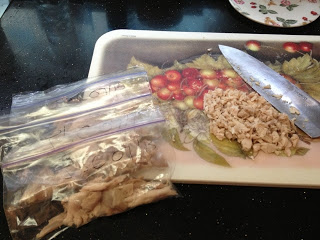
Part 2: Making the porridge
Ingredients:
2-3 Tbsp chopped and cooked chicken
500 ml (2 cups) chicken broth
2 Tbsp finely chopped onion
2-3 Tbsp of any of the following finely chopped (red or yellow peppers, potatoes, broccoli, zucchini, carrot. If you are not sure which foods your baby can eat check out Wholesomebabyfood)
2-4 Tbsp cooked white rice (you can use sweet rice or short grain rice)
Method:
Pour the broth into a pot and bring to a boil. Add the finely chopped veggies and cook for 5 minutes. Add the chicken and cooked rice. On a good medium heat boil the porridge for 5 minutes stirring constantly. Stop when you have reached a desired consistency. If your porridge seems too thick add a bit more broth or water. If it is too thin add another Tbsp of rice and bring to a boil again.


:)
*** Note: When giving your baby jook make sure that you also give him/her a lot of water. If your baby is not taking the water cup well, spoon-feed water. I usally give my son 1 spoon of water for every 2 spoons of jook.
Other Korean baby food recipes from Daughter of Korea:
Banana and spinach mash
Pear and jujube tea
Curled Mallow
Other Korean baby food jook recipes:
Beef Jook by Trained by Baby

Part 1: Preparing the Broth and Meat
Ingredients:
1 small stewing (spring) chicken
2-3 liters of water
Optional:
2-5 cloves of garlic
2-3 pieces of ginseng
2-5 jujubes (Korean dates)
Method:
First rinse the spring chicken thoroughly with cold water. Do the same for the jujubes, ginseng, and any other ingredients that you are using.
Place the chicken, ginseng, and jujubes in the rice cooker and add enough water so that it completely covers the chicken. Do not exceed the water maximum in your cooker. I used about 2 liters of water.
Turn the rice cooker on and find the Menu button. For those of you using a Korean rice cooker press the 메뉴 button until the Samgaytang 삼계탕 button is highlighted. Press start. If you do not have a samgaytang button try the steam 찜 button. The cooking time will take 1.5 to 2 hours.
Once the chicken is done, remove it from the broth and let it cool. Skim all the fat from the top of the broth. I got about 1 cup of fat skim. Toss it. Strain the broth and toss the garlic, ginseng, and jujubes. Let the broth cool and then bag it. You can use breast milk storage bags, you can freeze it in ice cube trays, or you can simply put the broth into plastic bags. I put two bags together and then put them around a medium-sized bowl. I then poured 500 ml (2 cups) of broth into the bags, tied them up, and then put them into the freezer. I got 4 500 ml bags of broth and 1 300 ml bag. Chop up the chicken and store it in plastic bags as well. I got 4 portions of chicken from the bird which was 500 g.
Part 2: Making the porridge
Ingredients:
2-3 Tbsp chopped and cooked chicken
500 ml (2 cups) chicken broth
2 Tbsp finely chopped onion
2-3 Tbsp of any of the following finely chopped (red or yellow peppers, potatoes, broccoli, zucchini, carrot. If you are not sure which foods your baby can eat check out Wholesomebabyfood)
2-4 Tbsp cooked white rice (you can use sweet rice or short grain rice)
Method:
Pour the broth into a pot and bring to a boil. Add the finely chopped veggies and cook for 5 minutes. Add the chicken and cooked rice. On a good medium heat boil the porridge for 5 minutes stirring constantly. Stop when you have reached a desired consistency. If your porridge seems too thick add a bit more broth or water. If it is too thin add another Tbsp of rice and bring to a boil again.


 |
| This picture of jook has curled mallow added to it. For more information on how to use curled mallow in jook go to this link http://daughterofkorea.blogspot.kr/ |
Store the cooled down porridge in a container and refrigerate for 3-4 days maximum. To reheat the porridge, add a few Tbsp of it to a pot and a little water or broth and bring it to a boil. There you have it, super tasty baby food on a budget.
:)
*** Note: When giving your baby jook make sure that you also give him/her a lot of water. If your baby is not taking the water cup well, spoon-feed water. I usally give my son 1 spoon of water for every 2 spoons of jook.
Other Korean baby food recipes from Daughter of Korea:
Banana and spinach mash
Pear and jujube tea
Curled Mallow
Other Korean baby food jook recipes:
Beef Jook by Trained by Baby
Tuesday, July 16, 2013
First Red Bean Shaved Ice of 2013
We made this the other day. As usual it was delicious and really hit the spot during the hot and humid rainy summer. Last summer we made our first shaved ice in June, and this year we are a bit late starting in July. It hasn't really been super hot; it's been more humid hot.


Here is more information about preparing shaved ice: http://daughterofkorea.blogspot.kr/2012/06/first-red-bean-shaved-ice-of-2012.html
Korean Baby Food Recipe (6 Months +): Banana and Spinach Mash
Ingredients:
1/2 Banana
3-4 Spinach Leaves
Directions:
Wash 3-4 spinach leaves and cut off the stems.
Boil the spinach leaves in 1/2 cup of water for 2-3 minutes or until tender.
Drain the spinach and squeeze out any water. Cut the spinach into 0.3cm pieces.
Mash the spinach and banana together.
Serve with water, barely tea, or pear and jujube tea.

1/2 Banana
3-4 Spinach Leaves
Directions:
Wash 3-4 spinach leaves and cut off the stems.
Boil the spinach leaves in 1/2 cup of water for 2-3 minutes or until tender.
Drain the spinach and squeeze out any water. Cut the spinach into 0.3cm pieces.
Mash the spinach and banana together.
Serve with water, barely tea, or pear and jujube tea.

Sunday, July 14, 2013

Friday, October 19, 2012

Thursday, October 18, 2012
Free Immunizations for Children and Babies in South Korea

It is now possible to get free children's immunizations at the pediatricans' clinics rather than going to the Gu office. For those living in Seoul, Gyeonggi, and Incheon (the first list) the following immunizations are free. For those living in other districts the same immunizations are not free but reasonably priced (the second list). The prices and immunization list are for those under 12 years old. You need national health insurance to get the free immunizations.
Free Shots:
B형 - Hep B
DTaP
소아마피- Polio
수두 - Chicken pox
MMR
일본 뇌염- Japanese Encephalitis
B형 - Hep B
DTaP
소아마피- Polio
수두 - Chicken pox
MMR
일본 뇌염- Japanese Encephalitis
See this post for more information: http://daughterofkorea.blogspot.kr/2012/03/south-korean-vaccination-schedule-and.html
Thursday, October 11, 2012
Using Soju as a Cleaner
You can use soju to clean the floors or greasy areas like the cupboards around your stove. All you need is soju, a spray bottle, and a rag. There are three methods for using soju on the floor:
1. Put soju into a clean spray bottle, spray the floor, then wipe it with a rag.
2. Pour about 2 TBSP of soju onto the floor and wipe it around.
3. Pour some soju onto a rag and wipe the floor.
You don't need water. The smell will quickly dissipate.
To save money on soju you can just collect unused/undrunken soju and pour it in a bottle rather than going out and spending money on a new bottle. This is the method Korean restaurant ajummas use. They are very resourceful people.

1. Put soju into a clean spray bottle, spray the floor, then wipe it with a rag.
2. Pour about 2 TBSP of soju onto the floor and wipe it around.
3. Pour some soju onto a rag and wipe the floor.
You don't need water. The smell will quickly dissipate.
To save money on soju you can just collect unused/undrunken soju and pour it in a bottle rather than going out and spending money on a new bottle. This is the method Korean restaurant ajummas use. They are very resourceful people.

Thursday, July 12, 2012
Mosquito Season 2012
It has been a very dry summer and there haven't been many mosquitoes but the rains finally started and with them the mosquitoes. I saw the mosquito truck for the first time this year which is very late.

Saturday, June 23, 2012

First Red Bean Shaved Ice of 2012

Check out this post on how to make it: http://daughterofkorea.blogspot.kr/2011/07/how-to-make-korean-style-shaved-ice.html
Monday, June 4, 2012
Rose Season in Seoul
May is the time of year when beautiful red, white, and pink roses bloom all around Seoul. It is such a lovely sight to see. The variety that grows here in Seoul seems to be a type of hanging/climbing rose. Most of the rose bushes have been planted along lattice frames or walls so that there is a symphony of mostly red all around the neighborhoods and streets of this large and crowded city.

The roses of Seoul have a special place in my heart as I moved here 5 years ago on May 22 and I distinctly remember how beautiful they were. When I leave Korea I will miss this time of year.

The roses of Seoul have a special place in my heart as I moved here 5 years ago on May 22 and I distinctly remember how beautiful they were. When I leave Korea I will miss this time of year.
Monday, April 9, 2012
What to expect when you are pregnant in South Korea: Going to the OBGYN
You might be surprised by a number of things when you go to an OBGYN in SK:
1. The amount of tests you will be offered.
2. The "wand" ultrasound which will be given up to about 10 weeks. (It is not painful BTW). Here
3. The fact that you can get an ultrasound + pictures for the low cost of 17,700 KRW (around $15.00 US) everytime you go to see the doctor and 3D ultrasounds + pictures for around 45,000 KRW (around $40.00 US).
These prices are for regular Korean OBGYN clinics. If you go to English-speaking clinics or the large hospitals you will be paying much much more. I go to MOTAE (02-888-0204) which is located on the corner of the Seoul National University Subway Station. There is an excellent doctor there who is very helpful and who speaks near-perfect English - Dr. Kim (a man).
TESTS: (the weeks are approximate and costs as of 2012)
First visit - The wand ultrasound + urine pregnancy test + pap smear
8 weeks - STD Blood Test
12 weeks - Nuchal Scan + Blood test for down syndrome
15 weeks - Quad Test (Blood Test)
20 weeks - Level 2 Scan (Ultrasound) - 47,000 KRW
Note: If any of these scans or blood tests come back with positive results for a chromosonal defect you will be offered an amniocentesis which is a long needle that will be inserted through your stomach to obtain amniotic fluid - the cost ranges from around 600,000 KRW to 1,000,000 KRW depending on the clinic and doctor. You can refuse to take any of these tests.
24 weeks - Glucose Test (Blood and Urine Test) - 36,000 KRW
28 weeks - 3D scan (Ultrasound) - 50,700 KRW
30 weeks - Regular checkup + sonogram - 17,700 KRW
32 weeks - Regular checkup + sonogram - 17,700 KRW
34 weeks - Regular checkup + sonogram + hemoglobin blood test + urine test - 35,000 KRW
36 weeks - Regular checkup + songram + non-stress test - 45,000 KRW
37 weeks - Regular checkup + songram + non-stress test - 45,000 KRW
38 weeks - Regular checkup + songram + non-stress test - 45,000 KRW
Delivery + 2 night stay - 240,000 KRW
Pediatric check-up + Baby's BCG shot - 100,000 KRW
Vitamin Information:
- up until 13 weeks you will be told to take a pre-natal vitamin with folic acid, after this time it is up to you whether or you want to continue or not.
- after 13 weeks you will be advised to take iron and Omega 3 supplements - you can buy these either at your clinic or at a pharmacy nearby.
- you can receive free supplements from your local bogeonso (gu office) (apparently you can also get free clothes, soaps, creams, ect. for your baby).
500,000 KRW KB Mom Card (고운맘카드):
- If you have health insurance in SK and are pregnant you can apply for the 500,000KRW KB Card which is basically free money that can be used at your OBGYN.
- To apply you must get a letter from your clinic indicating that you are pregnant.
- Take this letter + your alien registration to any KB bank.
- Once there a clerk will help you fill out the application form and give you a card that looks exactly like a bank or credit card. You must make an account with the bank first. I believe you must put 5,000KRW into your account, or else it costs 5,000KRW to set it up (one of those).
- You then use it at your clinic like you would a credit card.
- You then can use it everytime you go to the clinic for an amount up to 60,000KRW a day.
- The card becomes valid the day after you register for it.
- The 500,000KRW amount comes into effect April 01, 2012.
- The balance of your remaining credit can be found at the bottom of the clinic receipt under 잔액.
Finding Out Your Baby's Sex
- It's illegal for doctors in Korea to tell you the sex of your baby before 20 weeks.
- Nevertheless they will probably give you a hint such as "Your baby is handsome" or they will let you see the ultrasound and you can figure it out for yourself
Monday, March 26, 2012
South Korean Vaccination Schedule and Free Vaccinations from the Gu Office
Part of this information is from a friend of mine living in SK and the rest is from my vaccination booklet (which will be given to you on your baby's first visit to the doctor):
Vaccination Schedule:
Week 1: Hep B
0~4 weeks: BCG
1 month: Hep B
2 months: DTaP, Polio, Hib, PCV (Pneumococcal), Rotavirus
4 months: DTaP, Polio, Hib, PCV (Pneumococcal), Rotavirus
6 months: Hep B, DTaP, Polio, Hib, PCV (Pneumococcal), Rotavirus
after 6 months: influenza, once a year
12~15 months: chickenpox, MMR, Hib, PCV (Pneumococcal)
12~23 months: Japanese encephalitis, Hep A
15~18 months: DTap
4~6 years: DTap, Polio, MMR
6 years: Japanese Encephalitis
11~12 years: Td (dyptheria & tetanus); HPV
12 years: Japanese encephalitis
Free Vaccinations Offered by Your Local Gu Office (available to any child with South Korean National Health Insurance)
BCG
B형 - Hep B
DTaP
소아마피- Polio
수두 - Chicken pox
MMR
일본 뇌염- Japanese Encephalitis
Vaccination Schedule:
Week 1: Hep B
0~4 weeks: BCG
1 month: Hep B
2 months: DTaP, Polio, Hib, PCV (Pneumococcal), Rotavirus
4 months: DTaP, Polio, Hib, PCV (Pneumococcal), Rotavirus
6 months: Hep B, DTaP, Polio, Hib, PCV (Pneumococcal), Rotavirus
after 6 months: influenza, once a year
12~15 months: chickenpox, MMR, Hib, PCV (Pneumococcal)
12~23 months: Japanese encephalitis, Hep A
15~18 months: DTap
4~6 years: DTap, Polio, MMR
6 years: Japanese Encephalitis
11~12 years: Td (dyptheria & tetanus); HPV
12 years: Japanese encephalitis
Free Vaccinations Offered by Your Local Gu Office (available to any child with South Korean National Health Insurance)
BCG
B형 - Hep B
DTaP
소아마피- Polio
수두 - Chicken pox
MMR
일본 뇌염- Japanese Encephalitis
Tuesday, February 28, 2012
February 29, 2012 - Planting Has Started
I was out hanging the laundry today when I heard a rustling of plastic come from the locally-owned gardners' plots. To my surprise I saw that an ajumma had started planting what looked like lettuce? Maybe not as lettuce seems delicate anyway the 2012 gardening has started! Seems a bit early to me but the weather is calling for a high of 10 this Thursday and a high of 12 next Tuesday. Happy planting everyone!
Tuesday, January 3, 2012
Samsung Books: Excellent Korean and English Resources for Toddlers
I've been very impressed with Samsungbooks English and Korean educational books and toys for my toddler. The prices are very reasonable - for example their sticker books go for around 4,800 KRW and are very well made and kid-friendly.
I have not actually bought any of the resources online but you can check em out Here. I've been able to find samsungbook products at the local Bandi and Luni's bookstore. On the website you can find the resources in the pictures I have attached under Infant.
My son loves playing with the ABCs, sticker books, and blocks because they are challenging for him. He hasn't gotten tired of any of them yet and he's been playing with them for quite some time. Even though most of the resources are in Korean doesn't mean you can't use them in English. Whenever we do a Korean sticker book together I just use English cause well I don't want my son to speak Korean like me@@ kkkkk There are English sticker books availabe as well - we've been using this series.
I have not actually bought any of the resources online but you can check em out Here. I've been able to find samsungbook products at the local Bandi and Luni's bookstore. On the website you can find the resources in the pictures I have attached under Infant.
My son loves playing with the ABCs, sticker books, and blocks because they are challenging for him. He hasn't gotten tired of any of them yet and he's been playing with them for quite some time. Even though most of the resources are in Korean doesn't mean you can't use them in English. Whenever we do a Korean sticker book together I just use English cause well I don't want my son to speak Korean like me@@ kkkkk There are English sticker books availabe as well - we've been using this series.
 |
| These sticker books are pure quality. Children can learn shapes, colors, words, numbers all at the same time. |
 |
| J's absolute favorite. We play a game where he takes one of the small letters above and finds the same larger letter on our floor mat. |
 |
| This game is a bit challenging for J but he can do it with a bit of help. |
Sunday, January 1, 2012
Preparing for a Child’s Hospital Stay in South Korea
The South Korean Health System:
The system is private meaning it is not free. Korean National Health Insurance makes hospital stays reasonable – for example a 3 day stay due to pneumonia (including food + room + medicine + check-ups) costs around 180,000 KRW ($160.00 USD), and a 7 day stay for children’s heart surgery will cost around 3,000,000 KRW ($2,600.00 USD).
If you have children and are staying in Korea for a number of years you should consider getting private insurance as well. We pay 130,000 KRW ($110.00 USD) a month for an all-in-one private health and life insurance and get 100% coverage. We use무배당 하이라이프 퍼팩트패 키지 혐.
Check out this Seoul Global Help Center Link for a detailed explanation of Korean National Health Care Insurance.
Medi-givers NOT Caregivers:
In South Korean hospitals nurses’only roles are to pass out meds and give needles. They do not help patients go to the bathroom, eat, clean up, get dressed, take meds, or anything like that. That means you’ve got to be with your child 24-7 and if you are going in by yourself, then you’d best ask someone to come by and help you out.
My Hospital Story: Last time we were at the ‘Pil my son coughed so hard he puked all over the place and myself. I buzzed the nurse, she came and said OK but never came back. So I cleaned everything up while trying to take care of my sick young son. 30 minutes later the cleaning lady came and washed the floor, 45 minutes later a lady came to change my bedding. The same thing happened to my MIL the next day.
What is it like?
For me going to the hospital with my child is no longer a big deal (done it 4 times, plus 1 for MIL, plus 2 for myself@@). There’s always lots to entertain my son with and I don’t have to cook meals or clean the house^^. All the kids in the ward run around, play games, eat snacks, and watch TV. It’s really fun for them.
 |
| There's always lots for kids to do on the children's ward. |
It can be very tiring for the caregiver though and it’s a good idea to get someone to watch your child while you go out and get some exercise or fresh air. It’s also best to have someone come by everyday and collect your dirty laundry and bring fresh towels, snacks, ect.
Collectivist vs. Individualistic
I was reflecting on how different Korean culture is from Canadian. In Canada, kids stay in the hospital by themselves and the parents drop by during visiting hours. This situation would be absolutely unacceptable in Korea where co-sleeping goes on for years and years.
Koreans have a particular dislike for loneliness, aloneness. They are a very ‘together’ (collectivist) people. So when you go to the hospital expect to see fathers sleeping on cots, mothers, children, grandparents all surrounding/ sitting on/ a child’s bed with snacks and food containers everywhere. There are no visitor’s hours and family and friends can come and go as they please.
The Deal with Rooms:
Once you get to the hospital you will have a choice of a 1,2,4, or 6 person room(s). Most people want to stay in the 6 person room since it is the cheapest option so sometimes there will be none available. If that happens you have to stay in the 4 person room until a 6 person is available. Once when we went in for our son’s heart surgery they told us there were no 4 or 6 person rooms available! Luckily that got worked out.
Cost per day in KRW (approximately)
Beds | Cost |
1 | 300,000 |
2 | 160,000 |
4 | 70,000 |
6 | 20,000 |
*6 Bedroom Rules:
The prime spot is next to the window, as it’s the farthest from all the noise and has lots of extra space due to the window sills, the next best spot is next to the bathrooms, and the worst is in the middle. Newcomers are always placed in the middle, and when a spot opens up on either side, they go there. After you are placed in the #2 or #1 spot you can get comfy as you won’t be moved anymore. Of course if you want to stay in the middle that’s OK too.
What It’s Like To Be the Only Foreigner:
 |
| The prime spot - a window position in a 6 person room. |
It’s not a big deal really, the basic questions are: 1. Where are you from? 2. Is your husband Korean? 3. Does your child speak both English and Korean? 4. How old is your child? 5. What is wrong with your child? 6. How long have you been in Korea?
The most surprising thing is that everyone remembers me but I don’t remember them at all. On our last stay a woman called out my son’s name and said hello but I had no idea who she was. Then she went on to explain that she remembered me from a year and a half ago. …..I have absolutely no recollection of her. The same thing happened at the local doctor’s office. A woman approached me and told me she and her daughter were in the bed next to us the last time we stayed at the hospital. This embarrassed me a little because I wonder if she was the one who I asked to turn her music down….. A lot of the nurses mentioned to me how last time I was here my Korean wasn’t so great but now a couple of months later it’s so much better.
The moral of the story is that as a foreigner you stand out like a sore thumb so try to be on your best behavior.
What the Hospital Provides:
The children’s ward usually has the following: TV room, play room, library, showers, Internet kiosks, and drink machines. There is a kitchen area to wash dishes, get drinking water, microwave food, and throw away garbage. Dish soap and rags are not provided. Wheel chairs and strollers with special attachments for IVs are also provided but can be scarce. If you have a light and portable stroller you may want to bring it if you child will not be needing an IV.
****It will make your life so much better if you bring a WiBro connector so you can connect to the Internet on your own devices – we use the Olleh Egg Here.
Each room will have showers, fridges, a TV, and a bathroom or two. Toilet paper, hand sanitizer, and hand soap will be provided.
Each room will have showers, fridges, a TV, and a bathroom or two. Toilet paper, hand sanitizer, and hand soap will be provided.
Your space will have a bed, cabinet with a lock, and a few coat hangers (see picture above). Cots are found under every hospital bed so parents or friends can sleep in your allotted space. Sheets, pillow cases, and one blanket are provided.
Breakfast, lunch, and dinner are provided by the hospital if you ask for it. Be sure to ask the nurse responsible for you to order meals as soon as you arrive. If you have to cancel lunch or the meals all together you also do this by telling the nurse in charge of you.
The cost of one meal is 4,000 to 6,000 ($3-5 USD) and if you are with a child you can just share one meal rather than ordering two. There are usually 2 options given and you must write down which one you prefer. If you can’t do it on your own, ask a neighbor not a nurse. There are usually restaurants in the basements of hospitals.
Hospital gowns will be provided for your children but they are usually in rough shape. I always bring pants for my son as the hospital ones are too light and big.
The cost of one meal is 4,000 to 6,000 ($3-5 USD) and if you are with a child you can just share one meal rather than ordering two. There are usually 2 options given and you must write down which one you prefer. If you can’t do it on your own, ask a neighbor not a nurse. There are usually restaurants in the basements of hospitals.
 |
| A typical hospital meal. One is usually enough for both child and parent. |
What To Bring for Yourself and Child:
Absolutely Necessary | Need but can live without | Do not bring |
· Carrier | · Coffee, yogurts, snacks (You can buy this in the basement where there will be marts and 7-11s but it may be impossible to buy something, better safe than sorry). | · Anything clunky, large and unweilding such as suitcases. We always bring all of our stuff in a Bumbo bag because it's big but can be folded up easily and doesn't take up much space. |
· Ipad, Computer, or Iphone with children’s games and movies · WiFi/ WiBro connector | · Books and toys (There are children’s libraries and toys in the big hospitals). | · Expensive/nice clothing |
· Water bottle, plastic cups. (Drinking water is provided). | · Tissue and soaps (Toilet paper and hand soap are provided by the hospital). | · Smelly foods (^^) |
· Diapers, underwear, wipes, socks, pants, and comfy shoes for your child. Plastic bib. | · Stuffed toys, extra blankets and pillows for your child. | |
· Towels, face cloths, shampoo, conditioner, bags for dirty clothes, toothbrushes, toothpaste, moisturizer, ect. | · Stroller – parents prop the front part up on the IV stand and push them around – not sure if this is safe or not. The hospital will provide special IV strollers. | |
· Comfy clothes for yourself and a few pair of very comfy sandals/Crocs. Hospitals are usually hot so bring lighter clothing. | ||
· Blankets and pillows for hubby or whomever is staying with you. |
Breastfeeding?
No worries, every room has a fridge so you can store your breast milk easily, bed areas have electrical outlets, kitchens provide areas to clean pumps, and have sanitization machines. I was told that I could not breastfeed my son after his heart surgery but I did anyway. The nurses did not say anything to me about it.
Korea and Safety
I'll never understand why Koreans are so blasé about safety, especially the safety of children. This is a picture of a open window on the 7th floor of the children's ward. A small child could easy fall through it. I think I remember something on the news about a child falling from a hospital window a few months back. Unfortunately my Korean is not good enough to fully understand what happened. Shocking though, very shocking!

 |
| View from the 7th floor of the children's ward@@ |
Subscribe to:
Posts (Atom)